
Arida Medical Services

Handbook & Mandates

1. Information

Our purpose

Arida Medical Services is a governmental agency responsible for providing care and ensuring the safety of every person in Arida.

What we expect of you

Be the best version of yourself: honest, selfless, responsible, and able to take orders. Every member should work well together.

Performance of duties

Perform every duty with propriety and without favouring anyone, regardless of status, sex, race, religion or political position. Never let personal feelings, emotions or friendships affect your work. Carry out duties courteously and to the highest standard.

Core values

Passion Dedication Integrity Knowledge Courage Compassion Desire

2. Chain of command

Know who to speak to. Don't go straight to High Command, who are exceptionally busy. Abusing the chain of command, or being unkind to other members, risks removal. Current post holders are on the home page.

High Command · Chief, Deputy Chief, Assistant Chief
Only for issues that affect the whole department, not day-to-day questions or punishments.
Division Commander
Runs the whole operational side and oversees the three Division Chiefs. Keeps the divisions working together and reports to High Command.
Division Chiefs
Oversee and support Department Command, and are responsible for their departments.
Departmental Command · Captain, Lieutenant, Second Lieutenant
Run the department so High Command doesn't have to. Go to them about promotions, demotions or problems with another member.
Chief Paramedic
The most senior rank outside command, our sergeant major. Holds a Second Lieutenant's authority but manages nobody directly. Point of contact for anything outside department needs; provides MDT and call triage on duty.
Critical Care Paramedic
The most senior departmental rank. Responsible for hands-on care and triage in their department's area.
Advanced Paramedic
Experienced department leaders who lead crews on complex calls and mentor the ranks below.
Senior Paramedic · departmental supervisors
Handle minor issues, Q&As, feedback, training and supervision of lower ranks, and can make promotion recommendations via the form.
Paramedic, Advanced EMT, EMT · first response
The members you'll see most in the field. AEMTs have proven they can work with little supervision; EMTs have just passed training and are fully fledged, though not yet Paramedics.
Trainee EMT
Must read and understand this handbook and show it to an FTO. Can ride along with any member, but needs FTO sign-off to become an EMT. Trainees have one week before termination unless an FTO excuses them.

3. General rules

Do
  • Understand and follow the chain of command
  • Respect your colleagues
  • Perform your duties to the best of your ability
  • Remain professional at all times
  • Use correct radio communication and stay on the frequency
  • Respect the law and follow all guidelines
  • Stay at least 150m from an active gunfight or crime scene until Code 4
  • Log out if AFK for more than 15 minutes
  • Treat everyone equally, and give care by severity
  • Only enter a KOS zone after 2 minutes without gunshots (Search & Rescue)
Do not
  • Sell, donate or give away any equipment, clothing or vehicles
  • Possess any firearm
  • Be intoxicated to the point you can't act rationally
  • Pick up patients declared DNR or DOA
  • Revive or heal during an active situation
  • Let anyone persuade you a victim can't be revived
  • Be inactive for more than a week
  • Go AFK on duty to farm money
  • Enter DOC without permission (arrest there means removal)
  • Spawn vehicles inside buildings or objects
  • Wear unprofessional hats, or act unprofessionally
  • Put anyone in harm's way when driving or using equipment
  • Show favouritism to anyone

4. Equipment & vehicles

Every rank wears its own shirt with EMS pants, black boots and an invisible backpack; gloves are optional. Helicopters need Aviation training.

RankVehiclesHelicopters
Chief to Division ChiefAllAll
Captain, Lieutenant, Second Lieutenant, Chief ParamedicCharger–
Critical Care, Advanced, Senior Paramedic, ParamedicTahoe–
Advanced EMT, EMTAmbulance–
Trainee EMTAmbulance, doubled up with an FTO or EMT+–

5. On-duty equipment

EMS medical pack
All the medical items you need
MedPak 15
For revives; carried in your vehicle's inventory
Radio
Your primary means of communication
MDT tablet
Your handheld dispatch menu
GPS tracker
Your GPS
Food, water, repair kit
At least 5 food, 5 water and 1 repair kit

No face coverings such as gas masks (riots only) or balaclavas. Body armour only once Code Red is declared, fully white or black, with no weapon holsters.

6. Vehicle codes & radio

Code 1 · no lights or sirens
Not responding. Obey traffic laws.
Code 2 · lights only
Non-life-threatening call. Traffic laws apply.
Code 3 · lights and sirens
Life-threatening call. You may break traffic laws.

Keep radio traffic short, clear and professional, for example "[CH-01] is 10-76 to East Boat Shop." All 24 10-codes are on the Codes page.

7. Communicating with PD

Make sure PD frequencies are clear, then announce yourself as AMS ("AMS to PD") and wait for PD to confirm before continuing. Only contact PD frequencies to request assistance, or clearance to attend a call where LEO is present, including major crimes. PD or DOC contacting AMS will say "PD to AMS" or "DOC to AMS".

The Communications section of the handbook was a work in progress. It's now replaced by the Communications & Confidentiality mandate.

8. Declaring someone dead (DNR / DOA)

Replaced by mandate. The old handbook rule allowed DNR for breaking community rules (RDM, VDM). That is no longer allowed. Follow the DNR & Refusal of Treatment mandate.

  • Only a Senior Paramedic or above, on duty, may declare DNR or Refusal of Treatment.
  • DOA only for a patient who took their own life, or is stuck under the map or glitched. Alert command on duty.
  • Log every declaration with evidence on the AMS DNR/DOA channel before going off duty. The Reports page takes the same details.

9. Response, treatment & discharge

Medical response and custody

The nearest AMS unit responds and calls it out on the radio. On arrival, check the scene is safe. At an active gunfight, back off to 150m and wait for an officer to declare Code 4, or for two minutes without shots. The god-heal medkit is only for mass casualty events of 4 or more patients, because it doesn't encourage roleplay.

Treatment and discharge

Severe injuries are transported to hospital for full treatment. Patients revived by non-AMS aren't in AMS custody unless they need further treatment; help them when the scene is Code 4, but revives come first. A resuscitated patient isn't fully treated, so check they don't need more care before discharging them.

Hospital personnel

This section still lists the old doctor ranks, which have been removed in the restructure. Hospital personnel may use the god-heal medkit once roleplay has concluded. Awaiting update from High Command.

10. Patrol regions
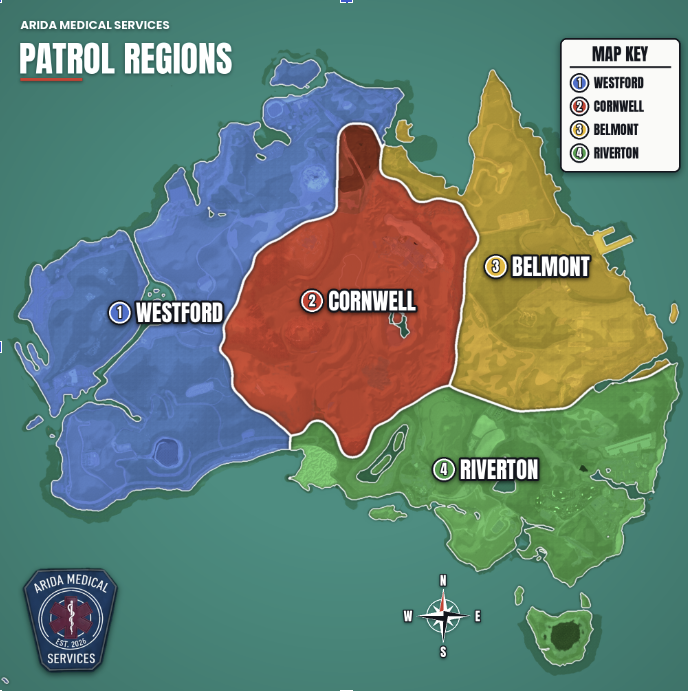
AMS patrol regions map: Westford, Cornwell, Belmont and Riverton

Arida is split into four patrol regions: Westford, Cornwell, Belmont and Riverton. Splitting up cuts response times, since driving across the whole island takes too long.

Pick your region when you clock in on the Duty Clock, going where nobody is covering. Command can move you when they're on.

11. Ride-alongs, leave & volunteers

Ride-alongs

Ride-alongs must be cleared by a Lieutenant or above and wear the ride-along hat at all times. The hat goes back to the hospital at the end. Anyone who keeps it is reported, blacklisted from ride-alongs and banned from applying for 2 weeks.

Leave of absence

LOA lasts roughly 1 to 4 weeks. Requests are on Discord. We understand breaks can come up suddenly.

Volunteer programme

Open to law enforcement officers who want insight into AMS, and to members who need longer away than an LOA allows without fully leaving. Volunteers follow department rules but lose access to promotions and their privileges.

12. Training

  • FTOs train new medics in the field. An FTO must be an AEMT or above and hired by HR.
  • Basic training: trainees ride along with FTOs, at least 3 times. The FTO makes sure they understand the SOPs and handbook, then reports to HR whether they're ready. Termination of a trainee who'd be a liability needs Lieutenant+ approval.
  • Advanced Vehicle Training: contact a Paramedic in the Tactical Medical Unit.
  • Aviation Unit Training: open to Paramedics in Search & Rescue and the Tactical Medical Unit.

Upcoming sessions are on the Training Calendar. The full FTO programme is in the HR & FTO SOP.

13. Rank structure

How to write each rank before a name.

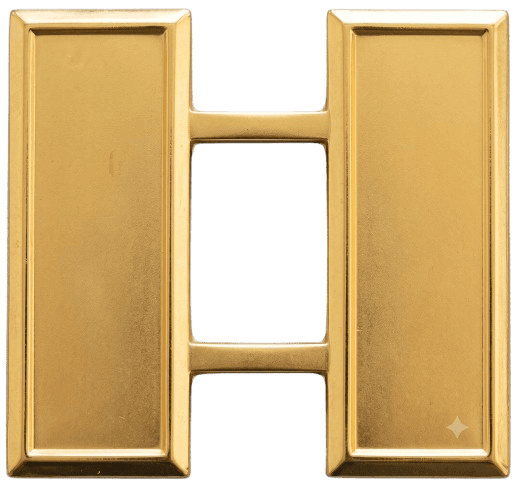
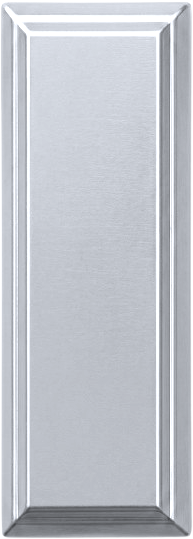
InsigniaRankWritten as
Chief of AMSChief. J. Wong
Deputy Chief of AMSDChief. J. Wong
Assistant Chief of AMSAChief. J. Wong
Division CommanderDivCdr. J. Wong
Division ChiefDivChief. J. Wong
CaptainCpt. J. Wong
LieutenantLt. J. Wong
Second Lieutenant2Lt. J. Wong
Chief ParamedicChPara. J. Wong
Critical Care ParamedicCCP. J. Wong
Advanced ParamedicAdvPara. J. Wong
Senior ParamedicSnrPara. J. Wong
ParamedicPara. J. Wong
Advanced EMTAEMT. J. Wong
EMTEMT. J. Wong
Trainee EMTTEMT. J. Wong

14. Promotions & time in grade

Every step needs no punishment points. Who's eligible right now is shown to command on the Command dashboard.

PromotionRequirements
Trainee EMT → EMTComplete the FTO programme
EMT → Advanced EMT14 days as EMT
Advanced EMT → Paramedic14 days as AEMT
Paramedic → Senior Paramedic14 days as Paramedic; LOI approved by a Lieutenant or higher
Senior Paramedic → Advanced Paramedic21 days; approved by a Lieutenant or higher; slot available
Advanced Paramedic → Critical Care Paramedic30 days; approved by the department Captain; slot available
Critical Care Paramedic → Chief Paramedic30 days; LOI approved by High Command; one position only
Advanced Paramedic or higher → Second LieutenantLOI approved by the department Captain and Division Chief; position available
Second Lieutenant → Lieutenant30 days; approved by the department Captain
Lieutenant → CaptainDecided by High Command
Captain → Division ChiefLOI submitted; decided by High Command
Division Chief → Division CommanderDecided by the Chief of AMS
High CommandAppointed by the Chief of AMS

Direct entry applications are approved by Captains and higher.

15. Conduct & progression

Professional conduct

You represent AMS at all times, in game and on Discord. Being rude or hostile, arguing with or undermining command in public, misusing the radio, MDT or channels, or anything that brings AMS into disrepute can lead to punishment points, demotion or removal.

Communication with and about command

Speaking to or about command disrespectfully, on any platform, may lead to discipline. Raise concerns through the chain of command or Internal Affairs.

Asking for promotions

Don't. Command monitors activity, conduct and performance. Asking only delays your promotion and may lead to discipline.

Leaving AMS

Give notice to your department command. Leaving without notice means a 30-day transfer and rehire block.

Department transfers

You need 60 days in your current department, a transfer costs at least two ranks, and both departments' command must approve.

16. FAQ

Who can train me?
Anyone with the FTO tag on Discord. Watch the Training Calendar for sessions. Command can also train you, but they're busy.
How can I be promoted?
Be active and dedicated. Command has the tools to see who's ready.
How many of us can be on the island at once?
No limit at the moment. There's no queue-skip whitelist, so be patient.

Department SOPs

Each department's own procedures, on top of the Main Handbook. Where an SOP and a mandate differ, the mandate applies.
Search & Rescue SOP
Locked. Only Search & Rescue, Specialist Operations command and High Command can open this SOP.
Internal Affairs Handbook
Locked. Only Internal Affairs, Administrative Operations command and High Command can open this SOP.
Human Resources & FTO SOP
Locked. Only Human Resources, FTOs, Administrative Operations command and High Command can open this SOP.
Still to add: Fast Response Unit, Emergency Response and Tactical Medical Unit SOPs. Each will be locked to its own department in the same way.

High Command mandates

Full text. Tap a mandate to open it. Any sanction can be appealed once, in writing, to High Command within 7 days; the sanction stands while the appeal is heard. Members of command face a higher sanction, and High Command may issue any sanction it sees fit.

› DNR and Refusal of TreatmentAMS-HC-M-2026-0001 · Chief Matteo Genovese · 21 Oct 2026 · Supersedes handbook DNR/DOA and IA Handbook 7.5

Every citizen has a constitutional right to medical assistance. AMS may only revoke it, by DNR or Refusal of Treatment, under this mandate. Any member who does so outside it is dismissed.

Constitutional basis. Section 2.3 gives every citizen a right to medical assistance, revocable only if they are combative, argumentative or a nuisance and pose a risk to correct procedure and EMS safety, and it must be documented. Section 3.7 exempts EMS from litigation but not internal discipline, so AMS discipline is the only check. Section 3.8 makes this mandate an SOP medics are legally required to follow.
Definitions. DNR: a downed patient is not revived for the current incident. Refusal of Treatment: AMS stops or declines treatment for a conscious patient. DOA: patient took their own life or is stuck under the map or glitched. Declining care: the patient's own choice, not a revocation. Authorised member: Senior Paramedic or above, on duty, in uniform.
3. Duty to treat. Treat every patient by severity. Care may never be withheld for unpaid bills (billing is handled by Finance & Legal, never at the scene), faction, gang, job or criminal status (including suspects and people in custody), a personal dispute or friendship, a request from police, DOC, another faction or a civilian, or because you're busy or near the end of a shift. An active situation is not a DNR: hold at 150m until Code 4 or two minutes without shots, then treat. A threatened medic may withdraw (10-32), but the duty to treat returns once the scene is safe.
4.1 The test. Both must be true: (1) the citizen is combative, argumentative or a nuisance, and (2) their behaviour risks correct medical procedure and AMS safety. Meets it: assaulting or threatening crew; repeatedly interfering with treatment; returning to violence straight after a revive. Doesn't: rudeness with no risk; RDM or VDM (report to staff); anything in Section 3.
4.2 Who may revoke. Only an authorised member. Nobody outside AMS can declare or request one. Below Senior Paramedic, request one on radio (10-11), or on Discord with evidence if none is on duty, and keep treating until approved.
4.3 Procedure. 1) Give one clear warning in roleplay where safe. 2) Confirm both parts of the test and keep evidence (a clip is expected). 3) Tell the citizen their right is revoked for this incident. 4) DNR: call 10-40. Refusal: stop treatment and ask them to leave, requesting police (10-32) if they won't. 5) Log it before going off duty: name, time, location, which part of the test was met, and evidence.
4.4 Scope. Current incident only. A DNR ends at respawn; a Refusal ends with the incident. No member may keep a personal or standing DNR list.
5.1 DOA. Declared by a Senior Paramedic or above; if none is on duty, any member may for those two reasons only and must alert command immediately. Logged as in 4.3.
5.2 Declining care. Explain the treatment and risk, offer it once more, confirm the decline clearly, tell them they can call again, and record it with time, location and any witness. A downed patient can't decline. Patients in custody may decline; tell the officer, who can't force or block treatment. Bill only for treatment given. Never pressure a patient to decline, threaten a DNR, treat someone who clearly declined, or fake a decline.
6. Sanctions. An unlawful DNR or Refusal, or withholding care without a lawful reason, is Neglect of Patient Care (Demerit 1.4): instant dismissal, no warning needed. That includes a revocation by someone below Senior Paramedic, one that fails the test or is based on Section 3, one for a bribe, favour or grudge, faking a decline, log or evidence, and approving or covering any of these. Suspects are suspended while IA reviews; High Command confirms dismissal and may blacklist. Lesser breaches (late logs, not alerting command after a DOA, not recording a decline, treating someone who declined) go through the Demerit System.
7. Oversight. IA reviews every DNR, Refusal and DOA log; while High Command leads IA, High Command signs off reviews. The declaring or approving member answers for it. Records are kept on the DNR/DOA channel and IA spreadsheet.
Open the original document
› Paycheck Farming and Recovery of Unearned PayAMS-HC-M-2026-0002 · Commissioner Joshua Wong · 22 Oct 2026

AMS is funded from a set budget. Paycheck farming takes money from the members who do the work, the departments that need it, and the citizens AMS serves.

Constitutional basis. 2.2 Right to Work depends on meeting AMS requirements, including doing the work you're paid for. 3.8 makes this an SOP. 3.7 protects EMS work only, and farming isn't EMS work; recovery is brought after dismissal. 4.1 and 5.2 give the State Judiciary authority over civil cases. 2.8 keeps the member's right to court, including representing themselves.
Definitions. Paycheck farming: being or staying on duty to collect pay without doing AMS work. Inactive time: any on-duty time that isn't active duty. Unearned pay: all pay received during inactive time.
3. Active duty standard. While on duty you must be doing at least one of: responding to calls or available to; patrolling your region; hospital cover; authorised training; department work assigned by command (HR, IA, Finance & Legal); standing by where directed. Answer radio and supervisors promptly and truthfully.
4. Prohibited. 1) AFK on duty for more than 10 minutes without telling dispatch or a supervisor. 2) Idling while ignoring calls. 3) Going on duty only around pay times. 4) Staying on duty while doing non-AMS activity. 5) Alts, other people or any method to stay on duty without being present. 6) Ignoring or repeatedly declining calls without good reason. 7) Off duty in the system but in uniform or vehicles, or the reverse. 8) Helping, covering for or organising others' farming. Not farming: quiet periods while available, and short reported breaks.
5–6. Evidence and investigation. Duty logs, call and dispatch records, MDT and call reports, supervisor reports, clips and witness statements, and Finance & Legal pay records. Senior Paramedic and above may report suspected farming to IA. IA opens a case, may restrict duty, works out inactive time, lets the member respond in writing, and High Command signs off before passing unearned pay to Finance & Legal.
LevelConductSanction
1. MinorOne short lapse, e.g. unreported AFK just over 10 minutesVerbal warning, logged
2. First offenceA clear instance of farmingDemerits plus repayment
3. RepeatA second proven offenceSuspension, loss of promotion eligibility, plus repayment
4. SeriousThird offence, organised farming, alts, farming while committing crime, or any farming by commandInstant dismissal, recovery and court proceedings
8. Recovery. Unearned pay = AMS pay rate × proven inactive time. Finance & Legal issue a Notice of Recovery with the amount, how it was worked out, a 7-day deadline, and a warning of court action. Pay in full on time and there's no court case for that amount; a payment plan may be agreed. Otherwise, or after a Level 4 dismissal, a Bar Certified member of Finance & Legal may bring civil proceedings; the member may defend themselves or appoint counsel, and ASP may help serve notices. Leaving AMS doesn't cancel the debt.
10. Oversight. IA keeps every case on file; Finance & Legal keeps every notice, repayment and court case; High Command reviews farming cases monthly.
Open the original document
› Off-Duty Conduct and Criminal ActivityAMS-HC-M-2026-0003 · Commissioner Joshua Wong · 22 Oct 2026

AMS is trusted by every citizen and faction. A medic who commits crime, even off duty, damages that trust and puts colleagues and patients at risk.

Constitutional basis. 2.2 employment depends on meeting AMS requirements, including lawful conduct. 2.4 off-duty members may carry lawful, licensed firearms; illegal and Class Three firearms are never permitted. 3.7 protects EMS work only, not off-duty crime. 3.8 makes this an SOP.
3. Off duty you must: obey State law and the Penal Code; not wear any AMS uniform, hat or insignia; not use any AMS vehicle, helicopter, pack, MDT, radio or equipment; not present as on duty or use your rank for advantage; not enter DOC without permission. Off-duty members who find an emergency call it in, and only treat after signing on. Lawful civilian jobs are fine, but not at the same time as AMS duty.
4. Prohibited at all times: membership of or work for a criminal group; illegal or Class Three firearms; using AMS information for crime (passing on police, AMS or patient locations, radio traffic or call details); giving criminals preferential treatment; selling, lending or giving away AMS equipment; bribes; hiding another member's crime.
5. Arrests and charges. Report any arrest, charge or suspect status to department command or IA within 24 hours, with date, time, charges, officer and outcome. Not reporting is treated as concealment. IA may suspend you for anything above a minor offence while a case is open. You keep your constitutional rights; AMS won't interfere with ASP or the courts. A not-guilty verdict or dropped charge ends any suspension, though IA can still act on breaches like criminal group membership.
ConductSanction
Minor offence, reported on timeLogged; no action for a first offence
Repeated minor offencesDemerits
MisdemeanourDemerits and suspension; a second is grounds for dismissal
FelonyInstant dismissal
Any Section 4 breachInstant dismissal; may be blacklisted
Not reporting an arrest or chargeDemerits; dismissal if it hides a felony or Section 4 breach
Using uniform, vehicles or equipment off dutyDemerits and repayment of any loss
Open the original document
› Major Incident ResponseAMS-HC-M-2026-0004 · Commissioner Joshua Wong · Lead department: Tactical Medical Unit

Without a clear lead at a major incident, medics arrive in the wrong order, enter unsafe areas and miss the most critical patients. This sets out who takes command and how AMS works with ASP.

1. A major incident is 4+ patients at one scene; an active shooting, hostage situation, riot or terror-type event with casualties; a multi-vehicle, aircraft or boat crash with casualties; HAZMAT, fire or contamination; a disease outbreak (10-99); or anything the senior AMS member judges normal response can't cope with.
2. Declaring. Any Senior Paramedic or above, or at ASP's request: "AMS Major Incident declared, [location], [type], [estimated patients]." It becomes every on-duty unit's priority unless already treating a critical patient. Inform ASP; alert High Command and the Division Commander on Discord. High Command may call in off-duty members.
3. Command. The highest-ranking AMS member on scene is Incident Commander, whatever their department; at equal rank, TMU takes command. Handover on radio: "[name] taking AMS Incident Command." The IC runs the scene and only treats if nobody else can. The senior TMU member (if not IC) is Tactical Adviser; if the IC overrules them on tactics, they say so on radio and record it. Only TMU enters the warm zone.
Roles. Incident Commander; Tactical Adviser (senior TMU); ASP Liaison (TMU); Triage Officer (Chief Paramedic, then Critical Care); Treatment Lead (Advanced or Senior Paramedic); Transport Lead (Emergency Response or Fast Response Unit); Rescue Lead (Search & Rescue). Everyone else reports to the IC on arrival (10-23).
4. Working with ASP. ASP owns the threat and scene security; AMS owns patients; neither orders the other's members. Zones are agreed with ASP, who decide safety: hot is ASP only; warm is TMU only with ASP escort and agreement, to stabilise and extract; cold (150m+) is all AMS. Body armour under Code Red only, plain white or black. No AMS member ever carries a firearm. Suspects are triaged the same as everyone; ASP stays with them, transport as 10-92. AMS takes no part in arrests, searches or questioning.
5. Triage. P1 red (immediate), P2 yellow (urgent), P3 green (minor), black (DOA or lawful DNR). By need only; the DNR mandate applies in full. Revives first; the god-heal medkit is allowed at 4+ patients; P1 and P2 go to hospital once stable. The Treatment Lead keeps a patient list.
6. Stand-down. The IC stands down once all patients are treated or moved and ASP closes the scene, and units return to their patrol regions. The IC posts a major incident report on Discord within 24 hours (the Reports page takes the same details). Larger incidents may get a debrief.
7. Sanctions. Demerits for entering a hot zone, or a warm zone without TMU status and ASP escort (suspension if a member is downed as a result); ignoring the IC; treating out of triage order; leaving without being released; or not filing the report. Carrying a firearm on scene: instant dismissal.
Open the original document
› Communications and ConfidentialityAMS-HC-M-2026-0005 · Commissioner Joshua Wong · Replaces the handbook's Communications section
2. Radio. The handbook's radio and PD procedures stay in force. Also: keep traffic short and in 10-codes; use callsigns and ranks, not names or nicknames; give only the patient details the call needs; never share the AMS frequency outside AMS; no jokes, arguments or personal chat during active calls; during a major incident, only the IC and assigned roles transmit unless urgent.
3. Discord. Professional conduct applies in every AMS channel and anywhere you're identifiable as AMS. Use channels for their purpose; don't ping or DM High Command for things the chain of command can handle; don't argue with command in public; keep IC and OOC separate where marked. LOAs, DNR/DOA logs, applications, promotion recommendations and incident reports go through official channels or the AMS bot; DMs aren't valid unless command asks.
4. Confidentiality. Patient information is shared only with treating AMS members, hospital staff, and ASP where a patient is in custody or a crime is involved; never with criminal groups, the public or social media. Internal information (AMS channels, command discussions, IA cases, rosters, budgets, applications, frequencies, MDT) stays inside AMS; no screenshots or recordings out without High Command's permission. IA cases are confidential to those involved, IA and High Command. This still binds members after they leave.
5. Speaking for AMS. Commissioner and High Command: anything. Division Commander and Chiefs: their divisions, operations and major incidents. Captains: their department, recruitment and training. Members appointed by High Command: their topic. Everyone else: nothing on behalf of AMS, only sharing what command has already announced. Official posts are approved by High Command. You can stream or post AMS roleplay, but not internal channels, IA cases, MDT details or patient information beyond public roleplay. Requests for comment go to High Command.
ConductSanction
Misuse of radio or Discord channelsVerbal warning, then demerits
Unprofessional or disrespectful communicationDemerits
Speaking for AMS without authorityDemerits
Sharing internal information outside AMSDemerits and suspension; dismissal if deliberate
Sharing patient information without needDemerits and suspension
Leaking to a criminal group, or for gainInstant dismissal and blacklist
Sharing the AMS frequency outside AMSDemerits; dismissal if given to a criminal group
Open the original document

Source: [SL] AMS: Main Handbook, the department SOPs and the five High Command mandates. The Google Docs remain the official copies.